
|
|
The Scottish Government recently launched a simplified planning document which replaces 17 separate planning policies. The new document sets out planning policy on topics such as housing, wind farms, flooding and the natural and built environment.
Also published today is a circular updating guidance on the criteria and processes when developers are required to make a contribution to the provision of local infrastructure, where a development would create additional infrastructure demands.
Go here to download the new planning policy (PDF)
Go here to download the circular (PDF)
[SOURCE: Scottish Government]
New York Times recently published When Parks Must Rely on Private Money by DIANE CARDWELL concerning the struggles of cities to fund the construction and maintenance of parks throughout the USA. Many parks are funded through selling of land or revenues generated by carparks or taxes from new nearby developments and others are funded by residents and companies donating funds in return for naming rights or plaques. Cardwell cites examples of parks that have been constructed with the use some private funding including Millennium Park in Chicago and the Highline and with the tradeoff causing issues in some cities.
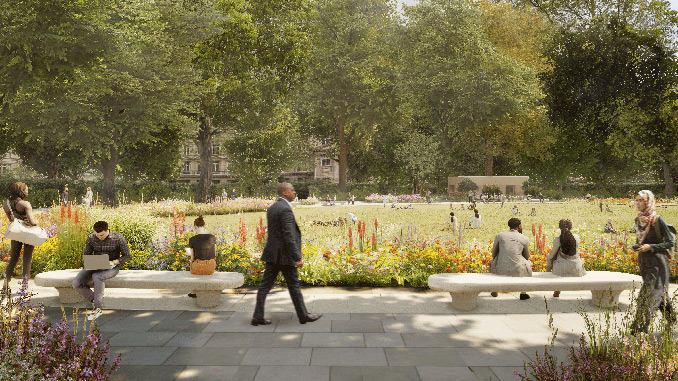
The article stimulated a few ideas I have had during my career. I find that funding of new or redevelopment of parks is a often a fine line between private and public funding, which often blurs the line between public and private space. Private funding often causing issues with residents because of naming or commercial activities in the new park that create a private area.
An ever-growing trend for cities around the world is to justify the cost of construction and maintenance of parks through inclusion of private funding or commercial activities such as paid parking garages, retail shops, restaurants, or areas that are commercialised for entertainment(concerts, festivals, etc). How to strike a balance between private and public funding is very complicated process for each city and requires research and consultation.
Many cities find it hard to redevelop parks with the use of public money as it is often controversial as parks are sometimes seen by residents as non-essential. Residents see hospitals, schools, and police as essential services within the community whereas parks are seen as non-essential and that public monies would be better spent on other services. To avoid this cities seek private funding in return for naming rights or a commercial development on or near the park. Now the question is how far to go with private funding and how much is the park compromised by accepting the funding in return for naming right or commercial development?
This issue of public and private funding will become more and more prevalent around the world as developers of retail and residential developments blur the line between public and private space by creating spaces in developments that are town squares and parks that can be accessed by the public. This blurring will cause some confusion with city residents as to what is public space and what is private. It also raises the question – Are developers going to develop parks and maintain them or will it always remain the domain of the local government?
Private development of public parks as apart of residential developments or commercial developments, which are then handed to government after certain period is already occurring in some parts of the world. Will this become a growing trend across cities for small and large parks? Or will it remain only in residential developments?
By Damian Holmes
Nancy Pollock-Ellwand has been appointed Dean of Faculty of Environmental Design (EVDS) at the University of Calgary. Recently, she was the chair of the School of Architecture, Landscape Architecture and Urban Design, at the University of Adelaide, Australia for the past three years. A graduate in architecture from the University of Manitoba and graduate in landscape architecture from Guelph University and she received her PhD in Planning at the University of Waterloo.
In her new position she wishes for students and staff to engage more with the architectural community.
[SOURCE: Calgary Herald - New dean passionate about architecture]
Nuszer Kopatz Urban Design Associates has joined Stanley Consultants, a large consulting engineering firms based in Denver. Stanley Consultants is a multi-disciplined firm that provides engineering, environmental and construction services throughout the United States and around the world.
Nuszer Kopatz, founded in 1991 by Mark Nuszer and Mark Kopatz, is a land planning, landscape architecture and community visioning firm. The capability brought by Nuszer Kopatz employees broadens Stanley Consultants’ portfolio of land development services.
“Until now our work has been focused regionally, so we’re excited about the opportunities this presents,” said Kopatz. Â ”It will still be business as usual for our existing clients. Â They’ll get the same personal attention but now have access to global resources. Â We’re looking forward to expanding our reach nationally and internationally.”
The Nuszer Kopatz staff will relocate from its current Denver office to Stanley Consultants’ Denver office.
[SOURCE: PRNewswire]
UC Berkeley Extension recently announced its new designation as a U.S. Green Building Council (USGBC) Education Provider. USGBC sets the standards for the green building industry in the United States and abroad through its Leadership in Energy and Environmental Design (LEED) Green Building Rating System certification program. UC Berkeley Extension is the first continuing education program at the University of California, and one of the few public continuing education programs in the country, to offer USGBC-approved course credits.
With the Obama administration’s budget proposal this week for $2.4 billion in energy efficiency and renewable energy programs—and the U.S. Bureau of Labor Statistics’ prediction of a 30 percent growth over the next decade in top green jobs such as mechanical engineer, environmental engineer, environmental educator, and landscape architect—the demand is growing among professionals for more green industry education.
The UC Berkeley Extension sustainability courses approved by USGBC are designed to meet that growing demand. They include advanced courses in solar, sustainable construction, renewable energy, transportation, clean technology, and sustainability leadership and management. All USGBC-approved courses are rigorously peer-reviewed and approved for credit toward LEED Professional Credentialing Maintenance.
UC Berkeley Extension’s Sustainability Studies program includes more than 60 courses for professionals in emerging green industries. The program emphasizes an interdisciplinary approach to sustainability in a broad range of important areas including green building design and construction, LEED, solar and renewable energy, climate change and land use planning, and clean technologies. This spring, UC Berkeley Extension offers several new sustainability studies courses, as well as two new specialized programs of study: Leadership in Sustainability and Environmental Management and Solar Energy and Green Building.
[SOURCE: PRnewswire]
Voxy.co.nz reports
Industrial-sized dumpsters, mini skips, a shipping container and exotic aquatic weeds are the four key elements in the exhibition garden being designed by Christchurch-based international designer Craig Pocock for this year’s Ellerslie International Flower Show.
“As landscape architects, we should be aiming to create landscapes with longevity that will survive changing demographics, community growth and fashion trends. Our landscapes need to be timeless designs that serve a community well for decades to make the most of the embodied energy costs that comes with creating and maintaining a landscape, especially our urban spaces”.
Read the full article at the [SOURCE: Voxy.co.nz - Water Oasis In An Industrial Setting]
Pandora Park Community Garden Society (Vancouver) has announced Green Shed: Pandora Park Community Garden Design Competition. An international design competition open to students and professional architects, landscape architects, builders, engineers, gardeners and designers.
The goal of this international competition is to generate buildable designs for a storage shed and outdoor common space for a new community garden that will showcase sustainable building strategies and materials. The winning design will be built by a team of volunteers over the summer of 2010.
For more information go to the competition website
View Larger Map
Page 1 of 32312345»102030...Last »
|
Our Landscape Book Picks from Amazon (Affilated Links)
|